
The Complete Buyer’s Guide for Printing & Packaging Businesses
If you work in the printing or packaging industry, you already know this truth: lamination quality is one of the first things a customer notices — and one of the last things they forget if it goes wrong.
The finish on a product box, the durability of a book cover, the shine on a brochure — that how to choose thermal lamination machine manufacturer in 2026 behind it. Yet most businesses treat this purchase like a commodity buy, comparing only prices and ignoring the factors that actually determine long-term value.
This guide is different. Whether you’re buying your first machine or replacing an aging one, we’ll walk you through everything that matters — from the technical basics to the hidden costs of choosing the wrong manufacturer.
What You’ll Learn in This Guide:
How thermal lamination works • 7 critical factors for choosing a manufacturer • The real cost of a poor choice • Why National Machines stands apart • 8 detailed FAQs with honest answers
1. What Is Thermal Lamination? (The Basics, Clearly Explained)
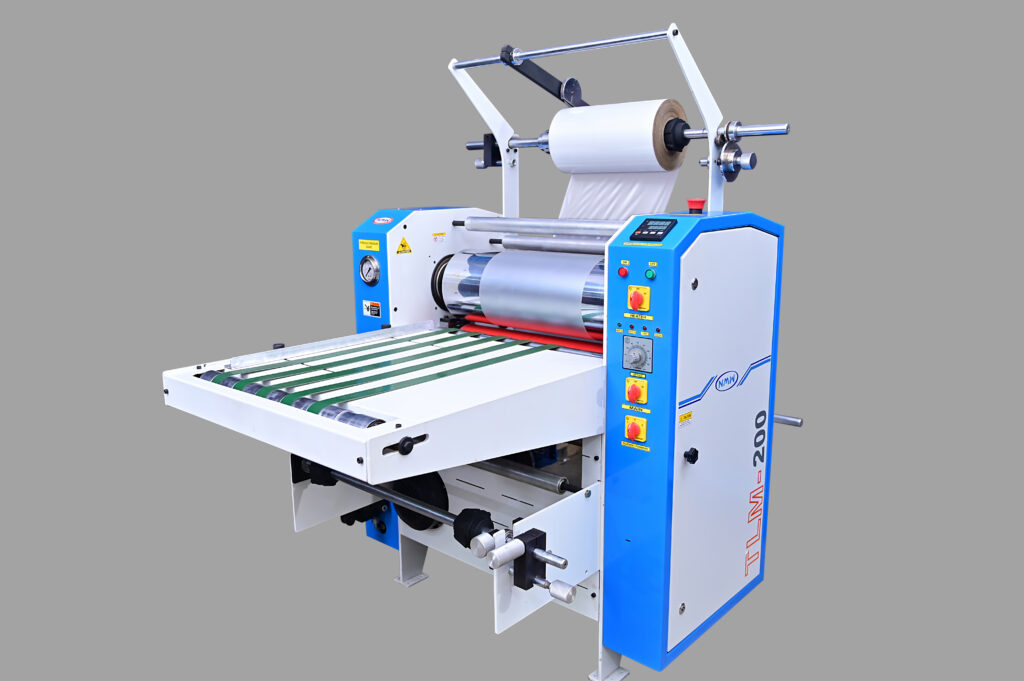
Thermal lamination is the process of bonding a thin plastic film — typically BOPP (Biaxially Oriented Polypropylene) or nylon — onto a printed surface using controlled heat and pressure. The result is a sealed, protected surface that looks and feels significantly more premium than uncoated paper.
The process accomplishes three things simultaneously:
- Protection — shields the surface from moisture, scratches, oils, and UV fading
- Appearance — delivers glossy, matte, or soft-touch finishes depending on the film
- Durability — extends the functional life of printed materials by 3x or more
A practical example: a book cover that would show wear within six months when uncoated can remain crisp and professional-looking for three to four years that how to choose thermal lamination machine manufacturer in 2026. For packaging, the difference between laminated and unlaminated boxes in humid warehouse conditions is even more dramatic.
The Three Lamination Types Most Commonly Used in Commercial Production:
Lamination Type | Best Application | Visual Result |
Glossy Lamination | Magazines, brochures, retail packaging | High-shine, vibrant color enhancement |
Matte Lamination | Premium packaging, corporate books | Elegant, non-reflective, sophisticated |
Soft Touch / Velvet | Luxury boxes, cosmetics, high-end brands | Silky texture, premium tactile feel |
2. Why Your Choice of Manufacturer Matters More Than the Machine Spec Sheet
Here’s a mistake many buyers make: they compare machines based on listed specifications — speed, film width, temperature range — and treat every manufacturer offering similar specs as interchangeable.
They’re not.
The manufacturer determines not just what’s in the machine on day one, but how it performs on day 500. Consider this real-world cost comparison:
Factor | Trusted Manufacturer | Unknown/Cheap Supplier |
Machine Downtime | Rare; fast resolution | Frequent breakdowns |
Film Wastage | 1–2% average | 5–8% or higher |
After-Sales Support | Dedicated service team | Limited or nonexistent |
Spare Parts Access | Readily available | 6–12 week wait possible |
Resale Value | High (brand recognized) | Near zero |
Operator Learning Curve | Documented, supported | Trial and error |
Let’s put that into perspective. If your machine experiences just two days of unplanned downtime per month due to poor manufacturer support, that’s 24 lost production days per year. For a mid-sized printing operation, that translates directly into missed deadlines, unhappy clients, and significant revenue loss — all from a single purchasing decision.
3. The 7 Critical Factors for Choosing the Right Thermal Lamination Machine Manufacturer
Factor #1: Verified Industry Experience
Years in business matter, but what matters more is relevant experience. Has the manufacturer served businesses like yours? Do they understand the specific demands of packaging versus publishing versus commercial printing?
Look for documented case studies, client references in your industry segment, and evidence of ongoing R&D investment — not just a polished sales pitch.
Factor #2: Automation Level and Future-Readiness
Semi-automatic and manual machines may appear cost-effective upfront, but in a competitive market, they become liabilities quickly. Fully automatic machines provide:
- Reduced operator dependency — one trained operator can oversee multiple machines
- Consistent quality — human error is virtually eliminated from the lamination process
- Higher throughput — production speeds 2x to 3x compared to semi-automatic setups
- Lower rejection rates — precise film tension control reduces waste significantly
Any manufacturer worth partnering with should have a strong fully-automatic product line with proven performance data.
Factor #3: Temperature Control Precision
This is a technical point that separates average machines from genuinely high-performing ones. Machines with only a single overall temperature setting create problems that are difficult to diagnose and fix:
- Air bubbles in the lamination — especially common in humid conditions
- Film curling at edges — caused by uneven heat distribution
- Inconsistent bonding strength — results in peeling over time
Premium manufacturers incorporate PLC-based zonal temperature control, allowing different sections of the machine to operate at independently optimized settings. This becomes especially critical when switching between film types or paper weights.
Factor #4: Realistic Speed Claims
Machine speed listed in a brochure is the theoretical maximum under ideal conditions. Real-world speed — accounting for job changeovers, warm-up time, film loading, and quality consistency at speed — is what actually drives your production capacity.
Before committing, ask these questions:
- Can you demonstrate the machine at rated speed while maintaining quality output?
- What speed adjustment is required when switching film types?
- What is the warm-up time per production shift?
- What is the maximum speed at which quality remains within specification?
4. Which Machine Type Is Right for Your Business?
The market offers three primary machine categories, each suited to different operational needs:
A. Roll-to-Roll (RTR) Lamination Machines
Best suited for: High-volume continuous production, large print runs, flexible packaging.
- Very high throughput (50–120 m/min in premium configurations)
- Minimal paper handling interruption — maximum production efficiency
- Higher initial investment, but significantly lower per-unit production cost
- Ideal for businesses running long, consistent job types
B. Sheet-Fed Lamination Machines
Best suited for: Short to medium print runs, varied job sizes, packaging boxes, books, and mixed production.
- Greater flexibility — job changeovers are faster and easier
- Better suited to environments handling diverse order sizes
- Moderate investment with strong ROI for small to mid-sized operations
C. Compact / Desktop Lamination Machines
Best suited for: Small print shops, design proofing, low-volume specialty work.
- Low initial cost and straightforward operation
- Not suitable for commercial-scale production environments
- Useful as supplementary or proofing equipment
5. Why National Machines Is a Manufacturer Worth Considering
Credentials and product lists are easy to publish. What’s more useful is understanding how National Machines actually operates — and why that matters to your business.
Engineered for Real Operating Conditions
National Machines designs its equipment with the practical realities of Indian and regional manufacturing environments in mind: inconsistent power supply, high humidity variations, dust-intensive environments, and the need for machines that can be maintained by locally-trained engineers. This is meaningfully different from imported machines designed for controlled European or Japanese factory floors.
Genuine Customization Depth
Beyond the standard product catalogue, National Machines engages with clients who have non-standard requirements. Whether it’s an unusual production width, a specific coating compatibility requirement, or integration with an existing automated line, the company has the engineering capability to design around your operation — not the other way around.
Support That Goes Beyond the Sale
A machine purchase is a one-time transaction. The service relationship that follows it is what determines whether that investment delivers value over five, ten, or fifteen years. National Machines maintains a dedicated service network, stocked spare parts availability, and a proactive maintenance approach that is reflected in the long-term satisfaction of their client base.
Accessible Price Point Without Compromising Quality
For medium-sized businesses where ROI calculations are tight, the value proposition of premium quality at a competitive price — without the import logistics, currency exposure, and remote service challenges of international brands — is genuinely compelling. National Machines occupies this space deliberately.
6. Pre-Purchase Checklist: 10 Things to Confirm Before You Sign
Use this checklist in any conversation with a manufacturer before committing to a purchase:
- Machine specifications are documented in writing — rated speed, film compatibility, paper thickness range, power requirements.
- Warranty terms are clearly defined — parts, labor, and duration stated separately.
- Installation and commissioning: included in the price or charged separately?
- Operator training: how many sessions, how many operators, and what does it cover?
- AMC pricing and exact coverage are clearly specified.
- At least two existing client references have been provided and contacted.
- Spare parts lead time for critical components has been discussed.
- Energy consumption verified — theoretical rated consumption vs. actual operational data.
- Film brand and type compatibility confirmed — is it open-standard or proprietary?
- Payment terms, delivery timeline, and installation schedule are confirmed in writing.
Frequently Asked Questions
Q1. What is the difference between thermal and solvent-based lamination?
Thermal lamination uses heat and pressure — no chemical adhesives, no solvents, no drying time, and no VOC emissions. It’s faster, cleaner, and environmentally preferable. Solvent-based lamination uses chemical adhesives, requires drying time, produces strong odors, and presents health and compliance challenges. Modern commercial printing operations have largely moved to thermal for these reasons.
Q2. Which film type — matte or glossy — offers better ROI?
It depends on your client base. Glossy film is less expensive and appropriate for high-volume commodity work — textbooks, standard retail packaging, general brochures. Matte and soft-touch films command premium pricing justification — cosmetics, luxury retail, high-end brand packaging. If your business serves premium segments, the per-unit margin on matte work can be substantially higher, making the slightly higher film cost well worth it.
Q3. How long does it typically take to achieve ROI on a lamination machine?
For fully automatic commercial machines at 60–70% or higher capacity utilization, ROI is typically achieved within 18 to 36 months. Key variables include job mix, overhead allocation, operator efficiency, and local market pricing for lamination services. A good manufacturer should be able to help you build a realistic ROI model before purchase.
Q4. Does climate affect lamination quality?
Yes, significantly. High ambient humidity — particularly during monsoon season in South and Southeast Asia — can affect film adhesion and create bubbling if temperature settings are not adjusted accordingly. Quality manufacturers address this through humidity-compensating temperature profiles or PLC settings that allow seasonal adjustments. This is a specific feature worth asking about if you operate in a high-humidity environment.
Q5. Is buying a second-hand lamination machine advisable?
It carries real risk. Second-hand machines can be a reasonable option only when: the original manufacturer or an authorized refurbisher has performed a documented overhaul, maintenance history is fully available, some form of warranty is included, and service support remains accessible. Anonymous second-hand purchases through brokers, without documentation or warranty, should generally be avoided — the downtime risk alone often exceeds any initial savings.
Q6. Are machines locked to specific film brands?
Some manufacturers build in proprietary consumable dependencies — meaning the machine is designed or calibrated to perform optimally only with their branded films. This creates long-term cost exposure and supply chain risk. Before purchasing, explicitly confirm whether the machine is open-standard compatible or tied to proprietary consumables. Premium manufacturers like National Machines support multiple film brands.
Q7. How many operators does a fully automatic machine require?
A fully automatic lamination machine typically requires one trained operator per shift for monitoring and oversight, plus one to two helpers for loading and unloading. Semi-automatic machines require two to three skilled operators per shift. Factor training time and cost into your operational planning — a well-trained operator on a good machine dramatically outperforms an undertrained operator on any machine.
Q8. Why does lamination sometimes develop bubbles, and how do you prevent it?
Bubbling is caused by one or more of the following: incorrect temperature settings for the film and paper combination being used, surface contamination on the paper or film, high ambient humidity, incorrect pressure settings, or dirty nip rollers. Prevention requires a disciplined maintenance schedule, correct temperature profiling for each film and paper combination, proper storage of paper and film in humidity-controlled conditions, and regular cleaning of the machine’s contact surfaces.
8. Where the Thermal Lamination Industry Is Headed (Next 3–5 Years)
Understanding industry direction helps you make a purchase that remains competitive over the machine’s entire lifespan, not just in year one.
The Rise of Eco-Friendly Film Alternatives
Biodegradable and compostable alternatives to conventional BOPP films are already commercially available and gaining adoption in European markets. As packaging regulations tighten globally — and sustainability becomes a client expectation, not just a preference — manufacturers who design machines compatible with next-generation eco-films will be significantly more relevant. Ask your manufacturer about eco-film compatibility today.
IoT Integration and Smart Production Monitoring
Real-time production data — film consumption per job, temperature logs, efficiency metrics, predictive maintenance alerts — is increasingly expected in modern manufacturing environments how to choose thermal lamination machine manufacturer
with connectivity and data output capabilities allow production managers to optimize operations, catch problems early, and document performance for quality assurance purposes.
Inline Integration with Digital Printing
Short-run digital printing has grown dramatically, and inline lamination — where the lamination machine connects directly to the digital press output — is becoming more common. Manufacturers capable of providing integrated solutions, or machines that can be adapted to digital-compatible speeds, will be preferred partners as digital printing continues to grow.
Premiumization in Packaging and Brand Presentation
Across FMCG, pharmaceuticals, e-commerce, and consumer electronics, there is a sustained trend toward premium packaging finishes. Soft-touch, anti-scuff, spot UV-compatible, and specialty lamination markets are growing. Businesses positioned to offer these finishes — with the right equipment — are capturing higher-margin work that commodity printers cannot.
Conclusion: The Smart Way to Make This Decision
Choosing a thermal lamination machine manufacturer is a long-term business decision with consequences that extend well beyond the initial purchase. The right manufacturer delivers reliable equipment, genuine post-sales support, and a partnership that grows with your business. The wrong one delivers frustration, downtime, and costs you didn’t anticipate.
The right manufacturer for your operation is one that:
- Understands the specific conditions in which you operate
- Builds machines that deliver consistent quality at production scale
- Provides genuine after-sales support — not just promises
- Has the engineering depth to adapt to your specific requirements
- Offers transparent pricing and honest ROI guidance
National Machines meets all of these criteria. With a strong track record in the Indian printing and packaging industry, proven technology, and a genuine commitment to long-term client partnerships, they represent a manufacturer worth serious consideration for any business looking to invest in reliable, high-performance lamination capability.
Your next step: Before making any decision, take the time to define your specific requirements — production volume, paper size range, budget parameters, and any special application needs. Then have a detailed conversation with National Machines. A manufacturer that listens carefully to your operation before recommending a solution is how to choose thermal lamination machine manufacturer which understands what a long-term partnership actually means.
About National Machines
National Machines is a leading thermal lamination machine manufacturer based in India, delivering high-performance lamination solutions to printing, packaging, and publishing businesses. With decades of engineering experience and a strong service network, the company serves clients of all sizes across domestic and international markets.
Target Keywords: how to choose Thermal Lamination Machine Manufacturer | Lamination Machine India | BOPP Lamination Machine | Automatic Lamination Machine | Packaging Lamination Solutions | Best Lamination Machine Manufacturer